
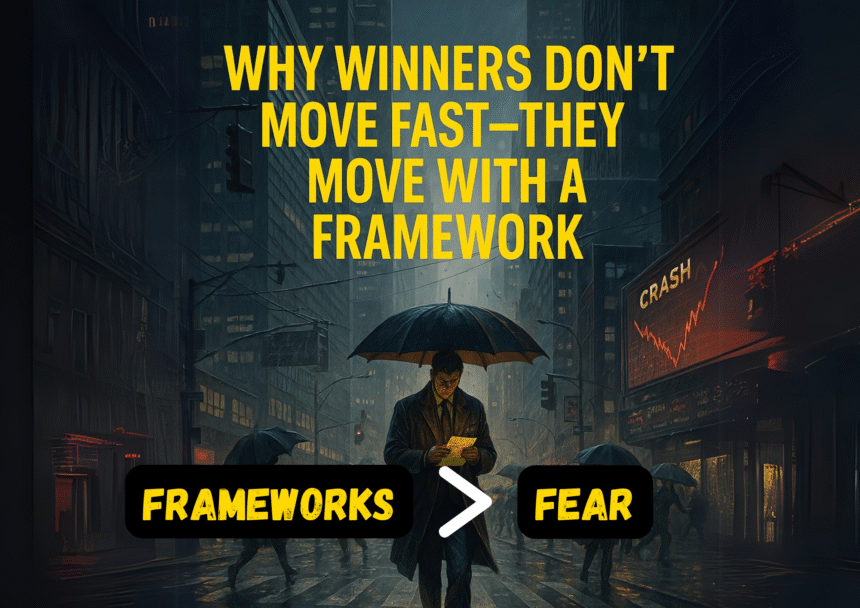
In a world chasing signals and speed, the best investors trust their frameworks—not the noise.
In the spring of 2020, when the world was locked indoors and markets were spinning out of control, a retired schoolteacher in Vermont quietly made her biggest financial move in 30 years.
She didn’t panic sell. She didn’t go “all in.”
She just followed a small plan she’d written down a decade earlier:
“Put $500 into the S&P 500 every month. No matter what.”
That was it.
While the rest of the world was refreshing news apps and watching their portfolios bleed red, she was making tea, reading books, and letting her plan do the work.
This isn’t a story about investing. It’s about something bigger.It’s about how some people, regardless of the moment, always seem to move with clarity—even when the world around them doesn’t.
What’s their secret?They build frameworks.
1. The Illusion of Control
In early April, the financial world witnessed a trillion-dollar swing caused not by data, earnings, or war—but by a fake tweet. It claimed former President Trump would pause his newly announced tariffs. Within minutes, the market surged. Moments later, when the tweet was debunked, $2.5 trillion vanished.
Absurd? Yes.Unfamiliar? No.
Over the past year, we’ve seen:
-
Tariff wars between global powers
-
Unpredictable Fed signals
-
CPI release days that feel like mini-earthquakes
We like to believe we’re in control. That with enough news, signals, and intuition, we can outmaneuver chaos.
But the truth is:The world doesn’t reward prediction anymore—it rewards preparation.
2. What Frameworks Actually Are
A framework is not a habit or checklist.It’s a worldview in action—a structure that stays steady even when the world doesn’t.
When you meet someone who always seems calm, who doesn’t react the way others do—it’s rarely luck or genius. It’s because they’ve already decided how they’ll respond before the chaos hits.
They’ve rehearsed it.Not just in their minds—but in how they live.
3. From Cricketers to Comedians: Frameworks in Motion
This idea shows up everywhere.
-
A cricketer at 20/4 on a tricky pitch doesn’t panic. They assess conditions, play session by session.
-
A stand-up comic doesn’t freeze when a joke flops. They pivot—drawing on muscle memory from hundreds of past shows.
What looks like calm under pressure is often just a practiced response.
The same is available to all of us—freelancers, students, founders.You don’t need to be a professional. You just need a framework.
4. How to Build a Personal Framework
A. Start With Self-Observation
In stressful moments—markets crashing, deadlines looming, relationships faltering—what’s your default reaction?
Escape? React? Freeze?
Most of us don’t fail due to lack of knowledge.We stumble because we haven’t seen our own patterns clearly enough.
B. Define Your Beliefs
Not philosophies—practical beliefs:
-
If I’m emotionally charged, I’ll wait 24 hours before deciding.
-
No single event should ruin my week.
-
Small steps daily > big steps occasionally.
These aren’t rules. They’re your compass.
C. Build Guardrails
In my early 30s, I said yes to everything—deals, people, projects.I burned out. Finances suffered. I nearly quit it all.
Now? I take on no more than three major commitments per quarter.
That’s my guardrail.
In investing: Never allocate more than 10% to a single position.In life: No meetings on Sundays. No notifications after 9 PM.
Guardrails aren’t restrictions.They’re terms and conditions for long-term peace.
D. Upgrade as You Grow
After the Terra Luna collapse, I added a new belief:Never call a token “blue chip” until it survives two full market cycles.
Frameworks aren’t fixed identities.They’re mirrors. And mirrors must adapt to light.
✅ Framework Summary
Here’s the takeaway:
-
Observe your stress patterns
-
Define grounded, repeatable beliefs
-
Build guardrails that protect your energy
-
Update your framework as life teaches you
Let your framework carry you—especially when nothing else will.
5. Why This Isn’t Just About Investing
This approach applies everywhere:
-
Fitness: Walk 10,000 steps, no matter the mood
-
Relationships: No emotional conversations over text
-
Work: Protect the first 2 hours of the morning for deep work
These aren’t habits.They’re quiet commitments to a better version of yourself.
6. The DCA Framework: Simplicity in Action
Today, the markets are loud.
Every headline feels urgent.Every dip feels like danger.Every rally feels like opportunity.
But I’m not reacting.I’m following a 12-week Dollar Cost Averaging plan:
-
Same amount weekly
-
Across high-conviction assets
-
No overthinking
It’s not flashy. But it’s peaceful.And peace outperforms panic—every time.
7. Why the Retired Teacher Wins
She didn’t know charts or cycles or CPI forecasts.
She just had a framework:
$500 every month. No matter what.
When the world collapsed in 2020, she didn’t flinch.She wasn’t faster. Or smarter.She just decided in advance—and stuck to it.
Final Thought
Storms are inevitable.But whether you drift or sail—that’s up to you.
Build your framework.Refine it often.Let it hold you steady when nothing else will.
If this spoke to you…
Stay connected.Subscribe to the newsletter for more reflections like this—quiet, clear, and intentional.
And sometimes, the most natural next step is to pass it along—to someone who’d appreciate it, just like you did.