

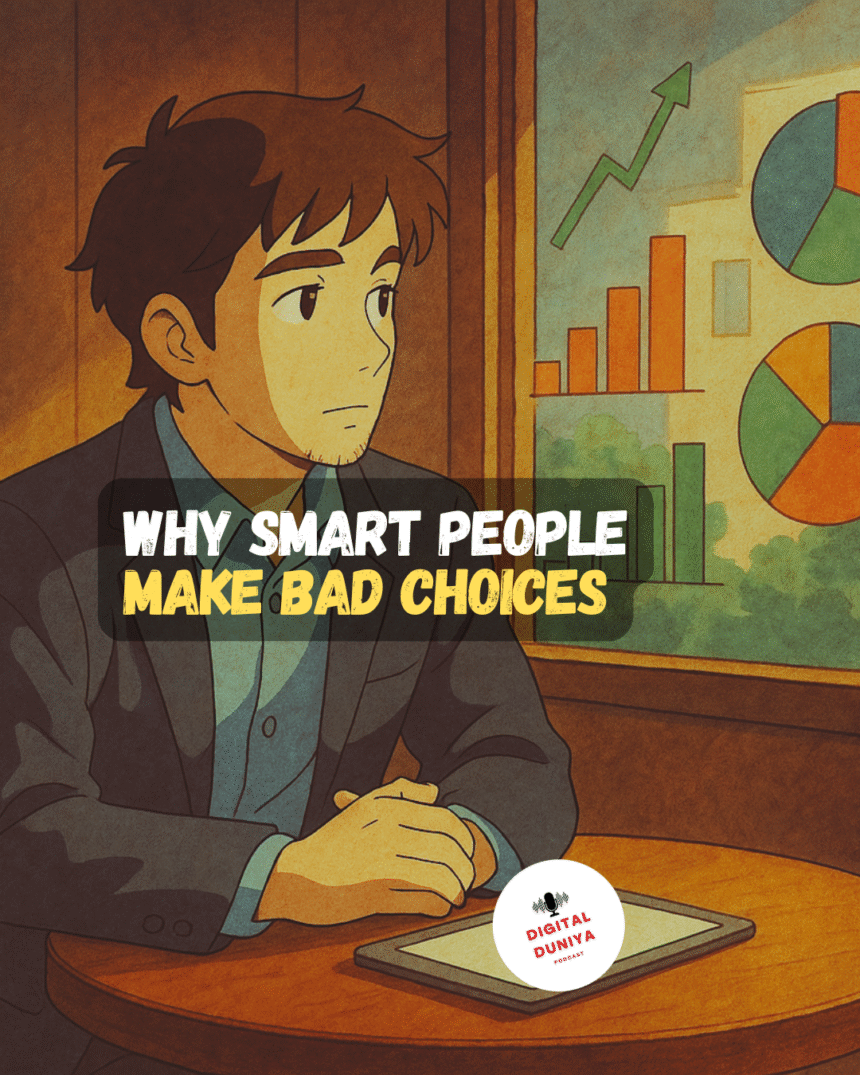
How Even the Smartest Investors Fall for Bias — And What Real Research Actually Looks Like
Smart investors don’t fail because they’re careless.They fail because they’re too good at convincing themselves they’re right.This newsletter covers how bias distorts clarity—and what real research actually looks like in a world full of noise.
I. Meet Varun: The Prototype of High Intelligence
Imagine I have a friend named Varun. He’s not real — but he could be.In fact, you’ve probably met a version of him.
Varun’s résumé makes rooms go quiet:IIT Bombay. PhD from MIT. Head of Research at a top-tier crypto fund.A sharp suit. An even sharper mind.The kind of guy who doesn’t just walk into a room — he rewires it.
He was known as the smartest person in any room — and to be fair, he usually was.Which made what happened all the more fascinating.
Varun went all in on a project called Astrolite —Tokenized real estate. Liquidity farming. Cross-chain composability.The whitepaper read like it had been written in zero-gravity.
He called it “a new layer of value abstraction.”He also called it “a sure thing.”
But Astrolite collapsed.And with it, so did Varun’s confidence.
When asked what went wrong, he offered a quiet confession:“I wasn’t researching. I was defending.”
II. The Lie That Sounds Smart: “I Did My Research”
Every industry has its polite lies.
In tech? “We’re here to solve real problems.”In finance? “Risk is already priced in.”In crypto? “I did my research.”
It sounds noble — like you spent nights decoding PDFs and scanning GitHub commits.
But usually, “research” just means:
-
You read a few bullish threads
-
Watched a slick video with motion graphics
-
Followed a handful of smart people who agree with each other
And now you’re calling it due diligence.
Let’s be honest:Most people aren’t researching. They’re building a case for what they already want to believe
.
III. When Intelligence Becomes a Liability
Here’s the paradox:The smarter you are, the easier it is to fool yourself.
Because smart people know how to connect dots. Build frameworks. Craft arguments. Quote Naval. Reference Taleb.
They sound right. They feel right.So they must be right — right?
That’s the trap.
Intelligence doesn’t eliminate bias.It just makes bias harder to detect.
Varun didn’t fail because he lacked data.He failed because he was too good at turning weak signals into strong conviction.
“Smart people don’t fail because they lack insight. They fail because they confuse cleverness for clarity.”
IV. Bias: The Invisible Operating System
Bias isn’t stupidity.It’s survival software — built for tigers and caves, not tokens and protocols.
And it’s always running in the background:
-
Confirmation Bias: You find what you want to find
-
Overconfidence Bias: You think you’re seeing clearly
-
Social Proof: You trust what’s popular
-
Narrative Fallacy: A good story > bad numbers
-
⏰ Recency Bias: You mistake patterns for principles
The more educated you are, the better you become at wrapping these biases in logic.
V. What Real Research Looks Like (But Rarely Does)
Real research isn’t loud. It doesn’t trend.It looks more like this:
-
Reading arguments that challenge your beliefs
-
Asking: “What would I need to see to admit I’m wrong?”
-
Writing out your logic before checking what your favorite influencer thinks
-
Studying failures, not just success stories
-
Looking for signals in discomfort, not confirmation
It’s slow.Uncomfortable.Often inconclusive.
Which is why most people skip it.
If this resonates, you might also enjoy this companion piece:Why Winners Don’t Move Fast—They Move with a Framework
VI. The Research Arms Race: Performance Over Truth
In the attention economy, the performance of research often beats research itself.
A confident voice. A clean chart. A quote from Balaji.That’s enough to get people to buy in.
Being convincing now matters more than being correct.
And the system rewards those who are loud, early, and wrong……over those who are quiet, late, and right.
VII. Varun, Revisited: Ego to Awareness
Six months later, I saw Varun again — this time in a quiet café.No charts. No alpha leaks. Just two cups of coffee and a pause in the noise.
He seemed calmer. Not jaded — just more skeptical. Not of the market. Of himself.
He smiled, and said:
“I’ve stopped calling it research unless I write it down. Until then, it’s just exposure.”
That line?That’s wisdom.Hard-earned. Fictional. But real.
Final Thought: Real Intelligence Begins Where Ego Ends
Smart people don’t fail because they’re careless.They fail because they confuse cleverness for clarity.
They forget that:
-
Knowing more doesn’t mean thinking better
-
Conviction without challenge is just ego in disguise
-
Research isn’t a badge — it’s a mirror
And most people are too scared to look into it.
But if you can?That’s where real intelligence begins.
If this hit a nerve…
Maybe it was meant to.Not because you didn’t know it — but because sometimes, we need a quieter voice to say it out loud.
If you want more reflections like this — thoughtful, intentional, and occasionally uncomfortable — you’ll find them here.
Subscribe to the newsletter.Not for noise. For signal.
And if someone came to mind while reading this —that one person who always seems a little too sure…Send this their way. Gently.