

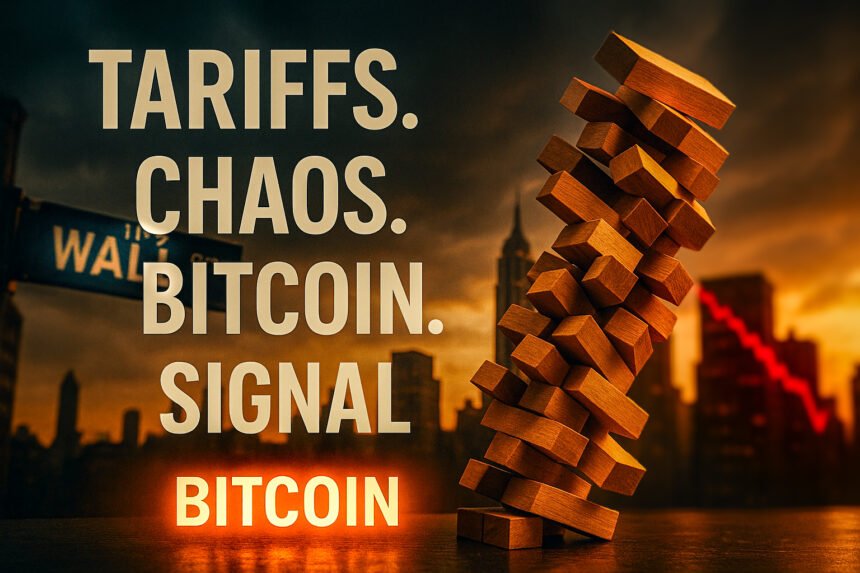
From Trade Wars to Buybacks — A True Story of Chaos, Power, and the Quiet Rise of Bitcoin
If you listen carefully, you can sometimes hear it.
Not the headlines. Not the market tickers. Not even the fiery speeches from world leaders.
But the creak—the subtle strain of a block sliding out from beneath a very large, very wobbly tower.
On April 2nd, 2025, Donald Trump pulled a block.
Chapter One: The Jenga Economy
Every economy is a tower of assumptions. Stacked together by trade, debt, central banks, stock markets, and diplomacy. The kind of tower where everyone agrees not to breathe too hard.
But Trump isn’t everyone.
On what he called “Liberation Day,” he yanked out a foundational block—announcing sweeping tariffs against China and others, designed to slash the U.S. trade deficit to zero. It was the kind of economic move you read about in textbooks under the chapter titled “Do This Only If You Enjoy Financial Collapses.”
He called it patriotic. The markets called it suicidal.
Chapter Two: When the Tower Wobbles
The reaction was immediate.
Stocks around the world dove. Bond prices twisted. The MOVE Index—Wall Street’s fear gauge for the bond market—spiked like a heart monitor in cardiac arrest. It hit levels not seen since COVID, 2008, or the Asian Financial Crisis.
The U.S. financial system had been ski-cut. Only this time, it wasn’t a mountaineer jumping on a snowbank—it was a president yanking a Jenga block with a grin.
And suddenly, hedge funds were sweating. Their models, designed for gentle breezes, were now flailing in a hurricane.
Chapter Three: The Billionaires Who Bet on Calm
Here’s the part they don’t tell you on CNBC.
Most hedge funds are like poker players who hate wild cards. They bet on stability, on things reverting to the mean. One of their favorite games is the treasury basis trade—a complicated arbitrage involving buying bonds and shorting futures.
It’s a nice, quiet strategy. Until volatility hits.
When the MOVE Index rises, banks demand more margin. That’s Wall Street code for “Give us more cash, or we liquidate you.” And when a dozen funds all get that call at once, the tower really starts to sway.
So the players began dumping bonds. Panic spilled into the system. The Jenga tower trembled.
Chapter Four: Enter the Cleanup Crew
This is where it gets interesting.
Instead of the Fed riding in on a QE horse, it was Scott Bessent, the new Treasury Secretary—also known on trading desks as The BBC (Big Bond Cowboy)—who stepped up.
His tool of choice? The Treasury buyback program.
Here’s the magic trick: The Treasury issues new bonds to buy back old ones. It doesn’t technically “print money.” But it floods the financial system with leverage.
RV (Relative Value) hedge funds get bailed out quietly. Liquidity returns. The tower firms up. And no one calls it QE… because technically, it isn’t.
But the effect? Pure stimulative dopamine for the markets.
Chapter Five: The Outsider Who Didn’t Flinch
While Wall Street panicked, one asset didn’t blink.
Bitcoin.
It bottomed at $74,500 and started climbing.
Because in every round of financial chaos, there’s one consistent pattern: When governments panic, they inject liquidity. When liquidity flows, Bitcoin rises.
It’s the outsider in the game—the one that doesn’t rely on central banks, interest rates, or whether Powell had a good breakfast.
And like in 2022, when the world was still processing FTX and the Fed was tightening, Bitcoin sensed something: the return of easy money—even if it came in a trench coat labeled “buybacks.”
Chapter Six: Where This Goes Next
This isn’t just about one tariff or one Trump tweet.
It’s a signal.
We now know that when the tower shakes too hard, the system responds. Not with speeches—but with money, leverage, and rescue mechanisms that keep the game going.
Bitcoin, with its fixed supply and anti-establishment roots, is positioned to benefit each time.
But here’s the kicker: The real rally may not even be Bitcoin’s final act.
Because once it breaches its old all-time high—$110,000—history suggests what comes next is the rise of the altcoins. But not the frothy nonsense of last cycle. This time, it’ll be the tokens with:
✅ Real revenues✅ Sustainable yields✅ Actual users and products
Chapter Seven: What You Should Watch
Want to track how this plays out? Set reminders for:
-
May 1st: Treasury’s QRA. More borrowing = more buybacks = more liquidity.
-
Mid-May: Actual U.S. deficit data (spoiler: it’s likely worse).
-
Next Fed meeting: Will Powell finally blink? (He already slowed QT.)
If Treasury buybacks ramp up and Powell holds steady, the system gets its liquidity fix—and Bitcoin gets its wings.
Final Thought
This isn’t just about crypto. It’s about seeing the system for what it is:
A fragile tower, managed by people who say one thing and do another.A world where “not QE” is still “go long risk”.And a future where understanding the moves—before they happen—is the edge.
Bitcoin didn’t flinch when the tower shook. It rose. Quietly, but purposefully.
Maybe it knows something the rest of the market still doesn’t.
They chase headlines. We decode signals.Subscribe to Digital Duniya — where we break down market chaos, spot the real moves early, and ride the waves before the suits even know they’re forming.No fluff. No noise. Just tomorrow’s edge, today.