

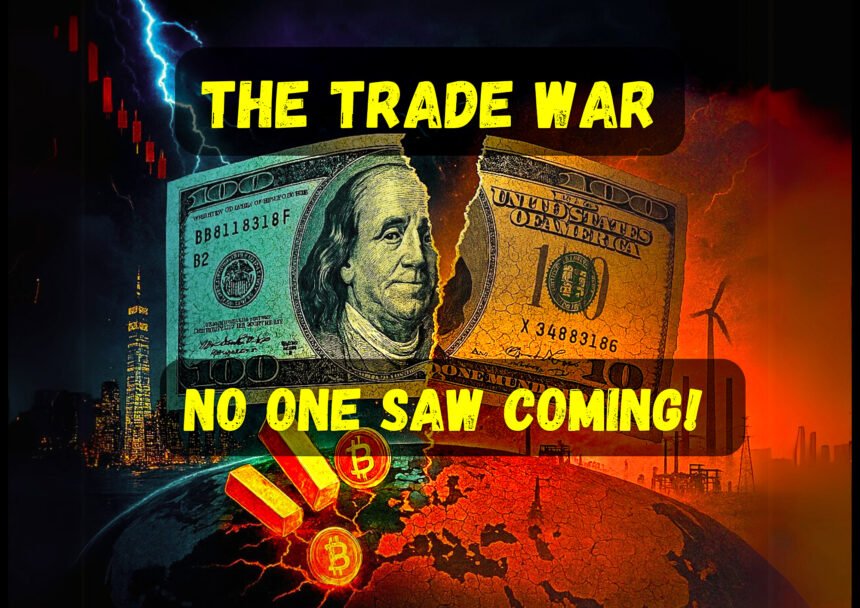
“The Hidden Cost of U.S. Tariffs: When the World Runs on Your Dollar ”
Imagine this.You run a busy chai stall in Delhi. Every day, you buy sugar from the wholesale market because it’s cheap and reliable. But one morning, they double the price of that sugar to support local farmers. Noble intention.
Only one issue:There’s no local supplier yet.Now you’ve got no sugar, no chai, and no customers.
That’s exactly what the U.S. just did to itself—except instead of chai, it’s the entire global trade system.
️ The Real Reason the U.S. Can’t Stop Running Trade Deficits
On April 2, the U.S. announced 125% tariffs on Chinese imports, and 10% on goods from the rest of the world.
It looked like a typical trade war.But it wasn’t.
This wasn’t about punishing China.This was about trying to reset a system that relies on U.S. dollars flooding the world.
You see, the U.S. dollar is the world’s reserve currency.Everyone from Saudi Arabia to Sri Lanka needs dollars — to trade, to borrow, to survive.
And how do they get those dollars?When the U.S. imports more than it exports — a fancy way of saying: runs a trade deficit.
So the very problem the U.S. is trying to fix (trade imbalance) is also the engine that powers the global economy.
Pull the brakes too fast, and… everything stalls.
Why Apple and Wall Street Are Nervous
Let’s take Apple.It makes most of its iPhones in China.
At 125% tariffs, that $1,000 iPhone could now cost $2,200.
So what happens?
-
Consumers stop buying.
-
Apple’s profits nosedive.
-
Markets panic.
-
And the global tech supply chain enters chaos.
You can’t just move a multi-trillion dollar supply chain to Ohio overnight.
What Happens When Dollars Stop Flowing?
Here’s the chain reaction:
-
Fewer imports = fewer dollars going out.
-
Foreign countries need those dollars to repay debts.
-
They start selling U.S. assets — stocks, bonds, and real estate.
-
That leads to a capital outflow — something we usually see in emerging markets.
And then something wild happened:
-
Stocks crashed.
-
Bonds also crashed.
-
Even safe-haven assets weren’t so safe anymore.
That’s not just volatility. That’s a system-wide liquidity shock.
Gold, Bitcoin & the New Financial Order
Guess what held up?
-
Gold hit an all-time high.
-
Bitcoin fell—but less than the NASDAQ.
Why?Because they’re neutral assets — not tied to one government, one bank, or one tariff.
As the world begins to rethink money, these assets are becoming the new collateral for a new kind of economy.
What Comes Next?
Lynn Alden calls it the beginning of a multipolar world — where no single currency dominates:
-
The dollar still matters.
-
But so will the yuan, euro, gold, and maybe even Bitcoin.
This isn’t just an economic reset.It’s a rebalancing of power, value, and trust.
Why This Matters to You
If you’re a crypto investor, a startup founder, or just someone trying to understand where the world is heading — this isn’t a side story.
It’s the story.
We’re not just witnessing a trade war.We’re watching a global financial system try to rewire itself in real-time.
✉️ Enjoyed This? Here’s What to Do Next:
Subscribe to Digital Duniya Newsletter — so you don’t miss the macro shifts shaping crypto, finance, and the digital future.
️ Share this with one person who still thinks this is “just about China.”
Forward to your Telegram group, Discord server, or WhatsApp chain.
Digital DuniyaTomorrow’s stories, shared today.