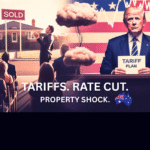


How U.S. Tariffs, Bitcoin, and Political Chaos Could Shake the Global Economy
It always starts the same way.A spike in prices. A strange headline. A new tax here, a supply shortage there.And then — your grocery bill doubles, your favorite product disappears, or your stock portfolio quietly bleeds red.
We’re here again.Only this time, the storm is forming in America — and the aftershocks will be felt across every major economy in the world.
What happens in the U.S. never stays in the U.S.
From Mumbai to Munich, Lagos to London — when the U.S. stumbles, the global economy sways.
Over the past week, investor Fred Krueger, macro strategists, and crypto veterans have sounded alarms. And while the opinions differ, one truth holds:
We are at a crossroads. And there are three roads ahead.
The 3 Global Scenarios We’re Watching Closely:
The Optimistic View: America adapts, markets recover, and global supply chains heal.The Pessimistic View: Shortages spike, a 1970s-style recession hits, and safe-haven assets like gold and Bitcoin soar.My View (The Middle Path): We hit turbulence, but avoid catastrophe — though the world wobbles with every U.S. misstep.
Let’s start with the best-case scenario.
️ The Optimistic View: America Pivots, The World Rebalances
This is the calm voice over the intercom:“Ladies and gentlemen, there will be some bumps, but we’ll land safely.”
Yes, the 104% tariffs on Chinese goods and 84% on Vietnam are aggressive. Yes, they’ll hurt in the short term. But this camp believes the U.S. economy is built to absorb shocks and adapt fast.
-
Essential goods like pharmaceuticals and semiconductors get quiet exemptions.
-
Supply chains rapidly reroute to countries like India, Mexico, Indonesia, and Eastern Europe.
-
The U.S. Federal Reserve cuts rates by July, easing liquidity and credit conditions.
-
A $2.5 trillion fiscal stimulus supports U.S. manufacturing, clean tech, and consumer spending.
As the U.S. engine restarts, global exports rebound.India gains new contracts. Southeast Asia regains momentum. European producers stay afloat.
Gold cools. Bitcoin consolidates. Global equity markets breathe.And optimism returns — cautiously.
️ The Pessimistic View: A 1970s-Style Domino Collapse
This is the silence before a storm.Investor Fred Krueger says this moment resembles 1973 — the oil crisis that created global stagflation, unemployment, and a financial reset.
Here’s how that plays out:
-
Late May to June: U.S. retailers run out of inventory. Tech, apparel, and home goods become scarce.
-
July: Consumer demand plummets. Unemployment rises to 6%. U.S. GDP contracts.
-
August: Wall Street tumbles. The S&P 500 and Nasdaq fall 15%. The Fed’s rate cuts are too little, too late.
But here’s the twist:This time, the pain isn’t isolated. It spreads globally — fast.
-
Vietnam and Taiwan lose U.S. demand.
-
India and Indonesia, expected to win supply chain business, see plans delayed.
-
Global capital exits emerging markets, creating currency shocks in South America, Africa, and Southeast Asia.
-
Oil and metal prices spike — then crash — as recessionary demand collapses.
Meanwhile, U.S. political winds shift.
Enter Alexandria Ocasio-Cortez (AOC) — a progressive U.S. Congresswoman known for bold taxation and climate-first policies.If economic frustration turns into political upheaval, she could emerge as a frontrunner for 2028 — threatening capital-heavy sectors like tech and finance.
In this scenario:
-
Gold hits $3,600/oz
-
Bitcoin crosses $100,000 as a hedge against fiat collapse
-
The global economy contracts under pressure it didn’t cause — but must still survive.
️ My View: We Wobble, But the System Holds — Barely
Here’s the truth I see:This is not the Titanic. But it’s not smooth sailing either.
We are entering a two-phase storm where the U.S. sneezes — and the world gets the flu.
Phase 1: May–July — Shock & Hesitation
-
Global investors panic.
-
Currencies in emerging markets weaken.
-
Prices rise. Consumer confidence falls.
-
Gold and Bitcoin gain momentum as capital flees volatility.
☀️ Phase 2: August–October — Soft Landing (But Not Recovery)
-
The Fed cuts rates again.
-
Tariffs are partially reversed behind closed doors.
-
Stimulus programs ease domestic U.S. pain.
-
Supply chains begin to shift — but slower than headlines suggest.
Bitcoin stabilizes around $95K.Gold settles near $3,200.Equities claw back losses.But confidence? Still shaky.
The world won’t collapse.But neither will it thrive.We will drift — cautiously — toward 2026, still looking over our shoulders.
So, What Does This Mean For the Rest of the World?
If you’re sitting outside the U.S., you still need to pay attention.Because when the U.S. catches a cold, the global economy sneezes.
If you’re in emerging markets, watch currency stability and export volumes. If you’re a retail investor, diversify — and don’t blindly chase panic trades. If you’re in tech or crypto, this might be your moment to build while the world is distracted. If you’re a student or job-seeker, this is the time to study systems, not headlines.
Final Word:
There are decades where nothing happens…And then there are weeks where decades happen.
We’re entering one of those windows.
This is not just America’s moment — it’s the world’s test of economic agility, resilience, and clarity of leadership.
Stay sharp.Stay global.Stay Digital.
Share the Signal
If this shifted your perspective even 1%, forward it to someone who thinks they understand markets — but might be missing the global angle.Let them see why value comes from you.
No need to explain.The signal speaks for itself.
Most people react.You anticipate.Because you read what others miss.
Share the signal. Be the source.