
How Trump’s trade war shockwave exposed crypto’s growing maturity
On April 2, 2025, Donald Trump did what Donald Trump does best — disrupt the system.
In a press conference that echoed across Wall Street and global trade desks, he announced sweeping new tariffs:
-
10% on all imports
-
34% on Chinese goods
-
20% on EU imports
The world flinched.
Stocks plummeted.The Nasdaq dropped 10% in just two days — its sharpest fall in five years.Financial news anchors reached for their “R” word: recession.
But something strange happened in the crypto markets.
Bitcoin? It dipped.Ethereum? A bit more.Solana? Took the biggest hit.
And then… it stopped.
There was no spiral. No panic. No cascading liquidations. No exchange outages.
In fact, crypto stabilized faster than tech stocks — and that’s worth pausing over.
This wasn’t 2020 anymore
To understand what changed, we need to rewind to March 2020, the start of the COVID crisis.
When global markets melted, Bitcoin halved in value within two days.Exchanges froze. DeFi collapsed. Liquidations were everywhere.It was a system-wide panic that revealed how fragile crypto truly was.
Fast forward to 2025:This time, a macro shockwave hit — but crypto markets held their ground.Not because they’re immune, but because they’ve grown up.
From rebel asset to macro player
The real story isn’t just that Bitcoin fell less than the Nasdaq.It’s why it behaved the way it did.
In the past year, crypto has changed.Not philosophically — but structurally.
-
Spot Bitcoin ETFs from BlackRock and Fidelity have brought institutional capital into the space.
-
Stablecoins now facilitate billions in cross-border trade and remittances — daily.
-
Ethereum restaking, Solana’s high-speed dApps, and Layer-2 innovation are expanding crypto’s utility beyond speculation.
This isn’t just retail and degens anymore.Crypto now sits at the same table as bonds, gold, and equities.
And here’s the line that captures it best:
Bitcoin didn’t soar. It didn’t collapse. It stayed standing — and in a storm, that’s what strength looks like.
The double-edged sword of tariffs
Tariffs are taxes — but they’re also declarations. They say:“We no longer trust the global system. We’re going our own way.”
Trump’s move is part of a broader shift toward economic nationalism.While meant to protect domestic industries, the consequences are global:
-
Import prices rise → domestic inflation ticks up
-
Trade slows → global liquidity contracts
-
Dollar strengthens → short-term drag on BTC
-
Miners face higher costs → less profitability, more pressure
-
Investors flee risk → temporary outflows from crypto
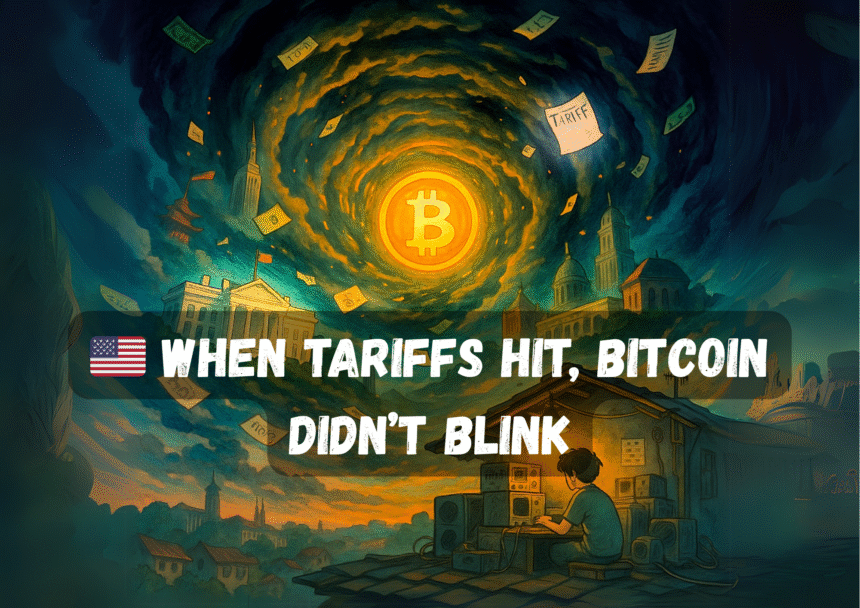
The miner in Gujarat
Now let’s ground this in the real world.
Meet Rajeev — a mid-sized Bitcoin miner based in Gujarat, India.He doesn’t follow U.S. politics. He’s focused on keeping his rigs running.But his supply chain depends on ASICs from China, cooling units from Taiwan, and logistics through Singapore.
After Trump’s tariffs, those suppliers get hit with new restrictions or reprice their exports.Shipping becomes unpredictable. Customs delays pile up.His latest ASIC order is suddenly 18% more expensive.Margins shrink. Expansion is put on hold.
Rajeev wasn’t in the room when Trump made that speech.But he felt the ripple — all the way in India.
Not everyone’s convinced
Let’s be clear — not all investors see this as bullish.Some still view crypto as a risk asset, and nothing more.
A rising dollar, tightening liquidity, and unstable geopolitics are headwinds.No matter how decentralized Bitcoin is, it still lives in a very centralized world — for now.
But what if that starts to change?
The seeds of something bigger
If the U.S. continues to weaponize the dollar and trade routes…If foreign governments seek alternative rails…If trust in traditional institutions continues to fade…
Then crypto — especially non-sovereign networks like Bitcoin — may evolve from an asset class to infrastructure.
And we’re already seeing the signs:
-
USDT and USDC adoption surging in Asia and South America
-
BTC being used as collateral in institutional portfolios
-
Governments quietly exploring crypto settlement layers for international trade
In short: the longer this tension lasts, the more relevant crypto becomes.
What smart money is watching
Here’s what macro-savvy investors are tracking:
-
Dollar Index (DXY): Strong dollar = short-term crypto drag
-
BTC–Nasdaq correlation: Breaking down = potential decoupling
-
Stablecoin flows: A trust proxy for cross-border use
-
Mining profitability: Stress-testing supply chains
-
Central bank signals: Markets are watching Powell — and now Trump
A quiet evolution
There was no headline. No “Bitcoin saves the day” moment.
Just a market that took a punch, absorbed it, and stayed standing.
That may not grab headlines — but in finance, resilience is underrated.
And in a world where trust is currency, crypto just earned a little more of it.
If you enjoyed this story…
Share it with a macro-curious friend. Subscribe for weekly essays where crypto meets global economics — minus the hype, plus the signal. Got thoughts? Reply and let’s chat.