
“How Trump’s tariff gamble triggered a bond market revolt — before CPI, before PPI, before anyone saw it coming.”
Trump’s April 9, 2025, tariff reversal wasn’t driven by inflation data — it came before CPI and PPI. This is the story of how the bond market spotted the danger first, and what that means for trust, policy, macro and crypto.
Trust Collapsed First: What the Bond Market Understood Before Anyone Else
There’s something curious about collapses.
They rarely begin with the data.They start somewhere smaller. A hesitation. A contradiction. A signal that doesn’t fit.
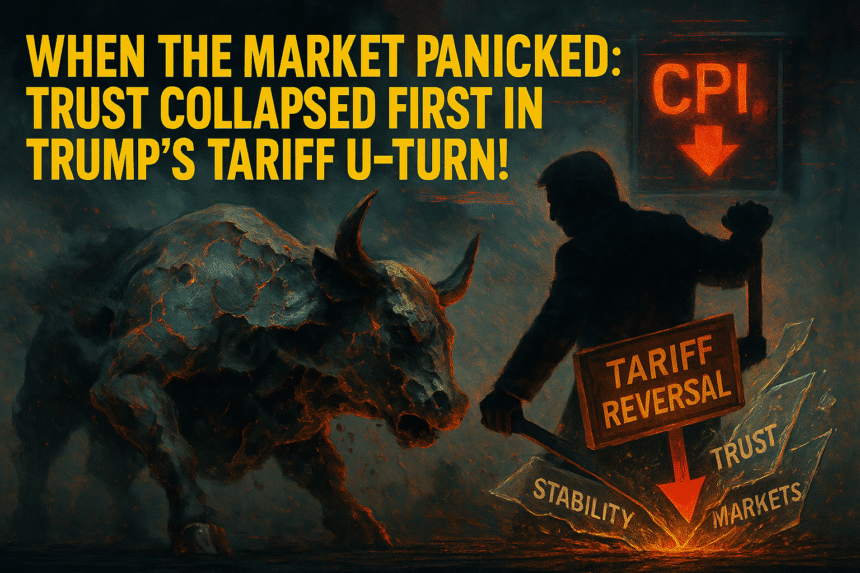
On April 9th, 2025, Donald Trump reversed course on his global tariff plan.The same tariffs he had framed as historic.The same ones announced just days earlier with full-blown fanfare.
And yet, just like that — paused.No real explanation. No policy brief. Just… reversed.
At a glance, it may have looked like politics or pressure.But if you were watching the bond market, you saw the truth:
The panic came first.The inflation data came later.And confidence broke faster than any CPI report could explain.
The Selloff Before the Data
Let’s walk through the week. Slowly.
Before April 9, before any CPI or PPI data hit the wires, the market had already moved.
-
S&P 500 fell 12%
-
Nasdaq posted its worst 2-day drop since 2008
-
10-year Treasury yields jumped 60 basis points — an explosive move
There was no war. No Fed rate hike.Even inflation data hadn’t arrived.
But something deeper had cracked.The bond market wasn’t reacting to a number.It was reacting to a pattern.
The Tariffs That Broke the Signal
Trump’s new tariff plan arrived like many of his decisions — abruptly.A sweeping “reciprocal” policy, calculated with this formula:
Their tariffs + our trade deficit = your new rate.
It sounded strong. But it lacked substance.
There was no scaffolding — no process, no global coordination, no risk modeling.It replaced vision with volatility.
And when you’re funding a $34 trillion U.S. economy, volatility isn’t strength. It’s a red flag.
For the bond market — the world’s largest and most sensitive capital pool — this wasn’t just erratic.It was dangerous.
Markets Don’t Wait for CPI
We often think markets are data-driven.But they’re actually clarity-driven.
They don’t wait for CPI reports.They don’t ask the Fed for permission.
Markets crave one thing more than returns:
Trust.
And when that trust vanishes, prices don’t trickle down — they collapse forward.
That’s what happened here.
Then Came the Numbers — But It Was Too Late
A few days after the crash, the March inflation data arrived:
-
PPI YoY: 2.7% (vs 3.3% expected)
-
Core PPI: 3.3% (vs 3.6% expected)
-
Month-over-month PPI: –0.4% — first drop in a year
-
CPI softened across categories
This should’ve been bond-friendly.Yields should’ve cooled. Volatility should’ve eased.
But the market had already made up its mind.
Because it wasn’t reacting to inflation.It was reacting to credibility.
⚠️ April 9: The Fold
Behind closed doors, Treasury Secretary Scott Bessent and NEC Chief Kevin Hassett brought the receipts:
-
Weak U.S. Treasury auction demand
-
Foreign capital exiting U.S. debt
-
Rising yields in a disinflationary backdrop
This wasn’t politics. This was mechanics.
“Sir, the market’s confidence is collapsing. If we can’t fund our debt cheaply, we won’t be able to fund it at all.”
Trump didn’t reverse tariffs because of China or Brussels.He reversed them because Wall Street said no.
And when the bond market — the world’s most trusted lender — says no?There’s no one else to ask. What Digital Duniya Readers Should Take Away
This moment wasn’t just about a tariff policy.
It was about a deeper, universal truth:
Trust is a leading indicator.Credibility is currency.And markets don’t wait for failure — they front-run it.
In the world of Finance, in crypto world, we often debate “narrative collapse.”
This was trust collapse — in the world’s most stable financial system.
And it’s a lesson for every founder, builder, and investor:
Process > Personality.Signal > Noise.Trust > Time.
Want more stories that decode market behavior before the data does?
Subscribe to Digital Duniya.
We follow the patterns, not the headlines.We break down the stories behind the price action — from Wall Street to Web3.
And if this reminded you of someone —someone who still thinks “the market overreacted” —
Send this their way.
Because this time?The market didn’t overreact.
It reacted faster than anyone else.